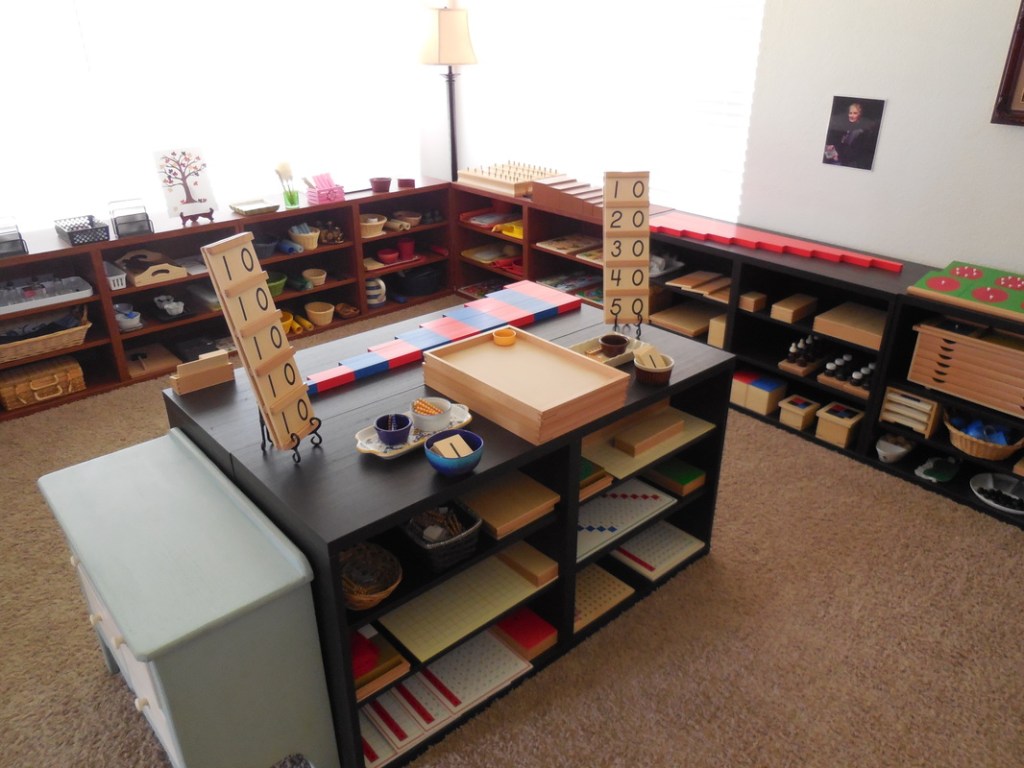
The Primary Program:
The Primary Program is designed for 2 1/2 – 6 year olds. Children of this age have an ‘absorbent mind.’ Maria Montessori coined this term to describe how the children literally soak up information, just as a sponge soaks up water. Due to this ‘absorbent mind’, the child will learn things during these primary years with minimum effort.
Through her observations, Maria Montessori learned that all children, during these early years, experience what she called Sensitive Periods. As an integral part of a child’s development, these sensitive periods lead to an attraction of certain stimuli. It is at these specific times that the child can most easily learn and acquire the skills and knowledge of the area to which they are being drawn.
The Primary Program consists of 4 main areas of study. These include Practical Life, Sensorial, Language and Mathematics. There will also be time spent in the study of science, geography, art, music and cultural studies.
Practical Life: The area of Practical Life acts as a bridge between home and school for the child. Here they will see familiar lessons. Lessons such as sweeping, dusting, and polishing. Practical Life incorporates the areas of movement, care of the environment, care of the person, and social relations. It is in this area that the child will gain independence, concentration, coordination of movement, a sense of order and adaptation to their environment. These lessons lead the child to develop himself as an individual and as a productive member of his community.
Sensorial: Sensorial will focus the child’s attention on the refinement of his senses. It brings order to all the sensorial impressions the child has already accumulated. The children will differentiate size, weight, gradation, color, texture, smell, taste, temperature and sound.
Language: This area is divided into 3 sections– Spoken Language, Written Language and Reading. In Spoken Language, the focus is on learning vocabulary, as the child is now in a sensitive period for the acquisition of language. They will also learn the sounds of letters and phonemes. With this knowledge behind them, the children rapidly enter the area of Written Language. Here they concentrate on learning how to write words, phrases and sentences. They practice constructing and diagramming phrases and sentences, which allows them to gather a better understanding of proper syntax and grammar. The child soon begins to read. Short words at first, but advancing quite quickly. Many aspects of language are integrated throughout the classroom.
Mathematics: In this area, work begins with manipulatives. Using these materials allows the child to grasp the concepts in their concrete form before moving on to the abstract. Quantity, symbol, operations, linear counting and decimals are some of the mathematics topics that are covered in the Primary Program
 MYSTICAL ROSE MONTESSORI